The Battle of Chosin Reservoir: A Study of Maneuver Warfare
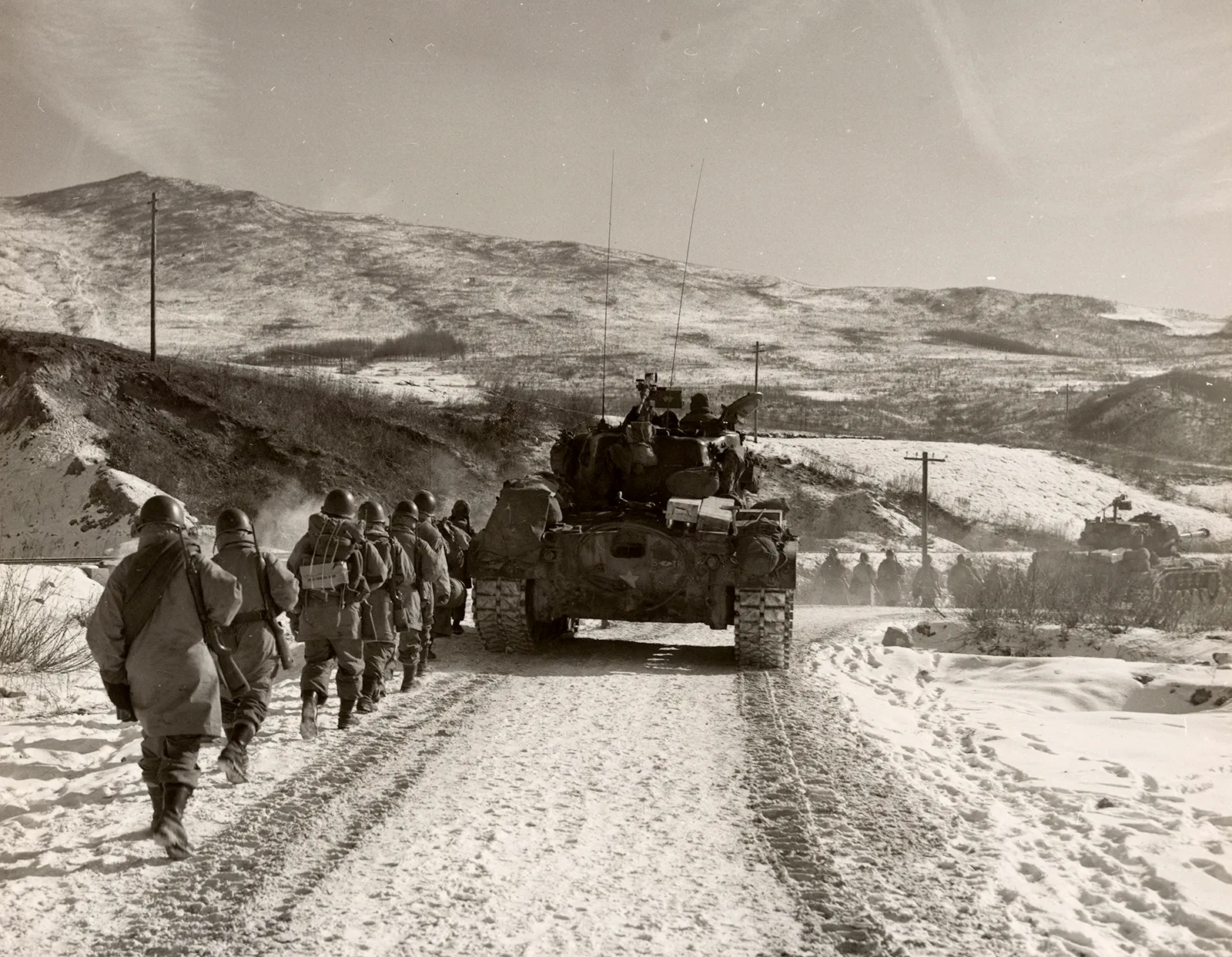
Men of the 5th and 7th regiments, U.S. 1st Marine Division, receiving an order to withdraw from their positions near the Chosin Reservoir, North Korea, November 29, 1950.
The Encirclement
The Battle of the Chosin Reservoir was one of the most vicious combat actions that the United States Marine Corps engaged in during the 20th century. This combat action pitted the overextended US Army X Corps against a surprise attack by the Chinese 27th Corps. US Forces were quickly surrounded and had to conduct a fighting withdrawal through miles of hostile territory during the coldest winter in decades. Intelligence failures regarding enemy strength and location allowed 12 Chinese People's Volunteer Army (PVA) divisions (120,000-150,000 troops) to mount a surprise attack on the 1st Marine Division.
The Decision to Fight South
On November 29, Almond acknowledged that the X Corps could survive only if its dispersed divisions headed for the nearest port. The Truman administration soon discarded the policy of unifying Korea by force, though it still wanted to save the Republic of Korea. Smith refused to abandon his division's equipment. Instead, he argued that the Yudam-ni–Hagaru-ri movement was the critical one. Once the two groups had united at Hagaru-ri, they could absorb ammunition and replacements by air and evacuate the worst wounded and frozen casualties. At that point the division could turn and fight its way to the coastal plain—"advancing in a different direction," as Smith phrased it.
The Breakout Begins
On December 1 the 1st Marine Division began the movement that eventually took its rear guard inside the perimeter established by the 3rd Infantry Division near Hŭngnam. In the course of this escape, the division rendered three more Chinese divisions ineffective in addition to the four that had already been ruined at Yudam-ni and Hagaru-ri. The 5th Marines walked the road to protect the vehicle train, while the 7th Marines plodded through the hills to break up Chinese "fire sacks" and relieve the Tŏktong Pass defenders. Their two artillery battalions moved by bounds to ensure continuous fire support, and Marine and navy fighter-bombers were on call during daylight to strike any suspected ambush.
Funchilin Pass and Escape
The reassembled 1st Marine Division reorganized, tried to eat and sleep in warming tents, and prepared to fight south to the coast. The real challenge was Funchilin Pass below Kot'o-ri, where the Chinese had destroyed a bridge over a chasm. The solution was to assemble a bridge that was air-dropped in sections, enough of which survived to allow vehicles to pass. A battalion of the 3rd Infantry Division stopped two attacks on the final Hŭngnam perimeter on December 3 and 15. By December 11, the 1st Marine Division had been loaded onto their waiting transport ships. Resistance by the Chinese had become almost token, their troops ruined by cold, starvation, and relentless X Corps firepower.
Tactical Victory, Strategic Impact
At the tactical level, Marines inflicted a 10:1 casualty ratio on Chinese forces (approximately 900 Marine KIA and 3,500 WIA versus 25,000-40,000 Chinese casualties). The division withdrew as an organized unit, maintained command structure, and preserved fighting capability. The Chinese 9th Army Group was rendered combat ineffective and took months to reconstitute. The 1st Marine Division's success enabled the evacuation of the entire X Corps (105,000 troops) and prevented the encirclement and destruction of a major UN force. While the overall strategic goal to reunify Korea failed, the Marine action prevented strategic defeat, maintained credibility of US commitment, and enabled the eventual establishment of an armistice at the 38th parallel.
Read the Full Research Paper
This overview is based on my complete academic analysis of the Battle of Chosin Reservoir, examining maneuver warfare doctrine, leadership, and tactical flexibility.
Download Full Paper (PDF)
Written for NS 4333: Fundamentals of Maneuver Warfare
Major Perras, Georgia Institute of Technology
October 2025